
About this fungus
Bulbous Honey Fungus is a fungus in the Physalacriaceae family. Its habitat and field characteristics are summarised below.
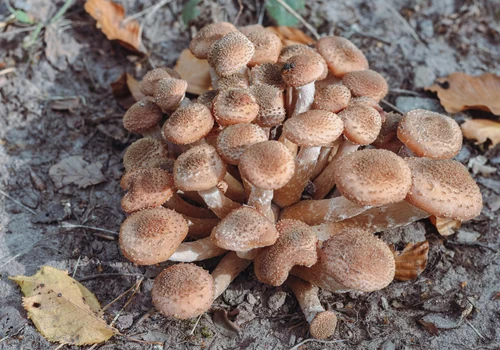
A honey-coloured woodland mushroom, often in groups, with small darker scales and a noticeably bulbous stem base.
What to check
Look for a white spore print, pale gills, a ring that may be thin or cobwebby, and black cord-like rhizomorphs around buried or exposed wood.
Variation
Caps range from yellow-brown to darker brown. The ring may collapse with age, and fruit bodies can appear to rise from soil over buried roots.
Lookalikes
Other Armillaria species overlap strongly and may require microscopy or DNA. Brown-spored Pholiota and Galerina differ in spore colour, with some Galerina being deadly.
Habitat and range
A decomposer and opportunistic root and butt pathogen of broad-leaved and coniferous trees. It fruits on stumps, roots and buried wood, mainly in the cooler fruiting season for its region.
Food safety
Edibility is uncertain or disputed.