
About this fungus
Bitter Beech Bolete is a fungus in the Boletaceae family. Its habitat and field characteristics are summarised below.
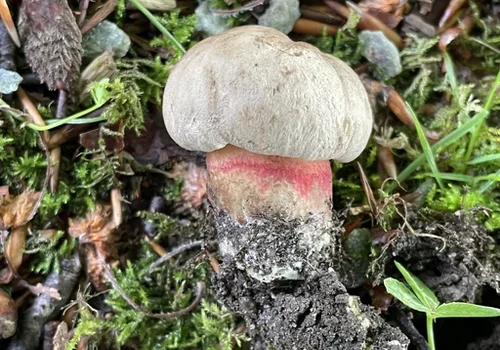
A sturdy, pale-capped bolete with bright yellow pores and a vividly red lower stem, both often showing blue bruising.
What to check
Look for a fine raised network over the upper stem, yellow pores that blue when damaged and pale flesh that may blue after cutting.
Variation
The cap ranges from whitish grey to olive-buff. Red stem colour can be extensive or concentrated lower down, while drought and age reduce bruising speed.
Lookalikes
Caloboletus radicans is usually paler-stemmed and often roots into the soil. Several Rubroboletus species have red pores or different stem and flesh patterns, and some are seriously toxic.
Habitat and range
Mycorrhizal with broadleaf and conifer trees. European records often involve beech or oak on acidic soil, but host emphasis varies across its broader northern range.
Food safety
Poisonous.
Photographs
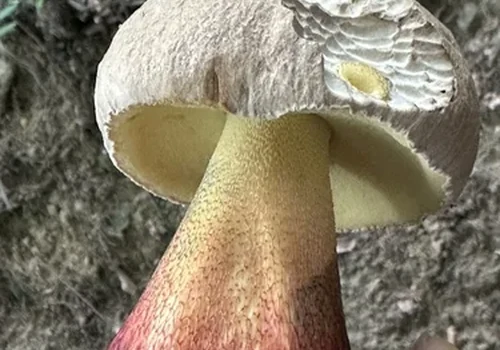 Photo: Albert Surmacz · CC BY 4.0
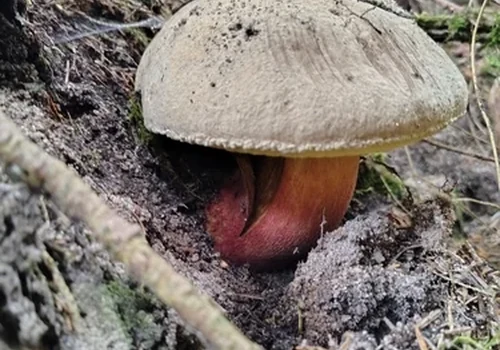 Photo: vuikaan · CC BY 4.0